

The Future of Construction: Embracing the HyPA Robot Revolution
In recent years, the construction industry has witnessed a significant transformation, driven by advancements in robotics and automation. A key figure in this evolution is Prof. Li Xiao’s team from the Department of Civil Engineering at HKU.



Prof. Li Xiao
As the inventor of the HyPA (Hybrid Pose Adjustment) robot, Prof. Li’s team is at the forefront of a technological revolution that promises to enhance installation accuracy, reduce rework, and significantly shorten project delivery times.
The HyPA robot is designed to replace traditional assembly methods, utilising a cable-driven pose adjustment robot with a vision-based positioning system that ensures precise installation. This innovation enables a significant reduction in assembly time—from over 45 minutes per module to approximately 15 minutes. By replacing seven to ten riggers, the HyPA robot not only streamlines the construction process but also enhances safety. The reduction in the number of workers at heights reduces the risks associated with traditional construction methods, such as falls and collisions.
Prof. Li has an impressive track record, with numerous contributions to the fields of AI and robotics for industrialised construction. His research focuses on integrating automation into construction practices, with the goal of enhancing efficiency and quality. Under his guidance, the development of the HyPA robot has garnered international attention, with its success in Mainland China sparking interest in its adoption in Hong Kong and beyond.

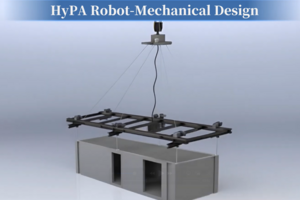
The economic benefits of the HyPA robot are substantial. In a single project, labour costs can be cut by up to $2.77 million in Hong Kong. This cost efficiency is particularly appealing to clients, who appreciate the robot’s ability to deliver high-quality results while minimising installation errors. Traditional methods often lead to significant discrepancies, with installation errors sometimes exceeding several centimetres. In contrast, the HyPA robot adheres to strict design specifications, ensuring precision that meets the demands of modern construction.
Client reception of the HyPA robot has been overwhelmingly positive. While the regulatory environment in Hong Kong presents challenges, the potential for the HyPA robot to transform local construction practices is evident. Prof. Li’s innovations are expected to pave the way for broader market adoption, particularly in regions facing housing crises and increasing demand for modular construction.
Looking ahead, the global market for prefabricated and industrialised construction is projected to grow significantly, with estimates suggesting an increase of US$214 billion by 2034. This growth is fuelled by the urgent need for housing and vertical infrastructure across various regions, including the UK, Singapore, and Australia. The HyPA robot is poised to play a vital role in meeting these demands, offering innovative solutions to complex construction challenges.
Moreover, the introduction of the HyPA robot presents an opportunity to attract a younger and more diverse workforce to the construction industry. By reducing the reliance on manual labour and enabling human-robot collaboration, the HyPA robot can make construction roles more appealing to young people, including women, who are underrepresented in the field. This shift could help address the industry’s aging workforce issue and foster a more inclusive environment.

The implications of integrating robotics into construction extend beyond immediate efficiency gains. As the industry moves towards greater automation, stakeholders will need to adapt to new technologies and methodologies. Prof. Li’s ongoing research in areas such as production robotics and AI-generated modular building layouts is further enhancing the efficiency and quality of construction processes.
In conclusion, the HyPA robot, developed by Prof. Li’s team, represents a pivotal advancement in the construction sector. Its ability to enhance accuracy, improve safety, and reduce costs positions it as a key player in the future of the construction industry. As the industry embraces these innovations, it stands to benefit not only from increased productivity but also from a revitalised workforce that reflects the diversity and dynamism of modern society.
Acknowledgments
The work detailed in this report is funded by grants from HKU, Logistics and Supply Chain Multi-Tech R&D Centre Limited, China State Hailong Construction Technology Company Limited, and the Hong Kong Polytechnic University.